
You’ve probably seen those Etsy shop success stories floating around — the teacher who made $3,000 her first month selling printables, the side hustler pulling in $800 from worksheets she made on a Tuesday afternoon. And if you’re honest with yourself, your first reaction was probably “okay but how though.”
Because the idea of starting an Etsy shop sounds amazing until you actually sit down to do it. Suddenly there’s Canva templates to wrestle with, pricing research rabbit holes, copyright questions, and a very blank screen staring back at you. Sound familiar?
Here’s the thing — it actually doesn’t have to be that complicated. The reason most teachers never get their Etsy shop off the ground isn’t lack of talent or time. It’s the setup overwhelm. And in 2026, there’s a smarter, quieter way to do this that most people still haven’t found.
This post is going to walk you through the exact lazy-but-strategic approach to starting an Etsy shop for teachers — from building your first product line to listing it in a way that actually gets found. We’re covering what to sell, how to create it fast (like, single-afternoon fast), and how to market it on Pinterest without spending hours on graphics.
Just so you know — some links in this post are affiliate links. If you grab something through my link, I may earn a small commission at no extra cost to you. I only ever share things I genuinely use or love. ✨
Why So Many Teachers Stall Before They Even Start
Let’s just name it plainly: the teacher-to-Etsy-seller pipeline is genuinely exciting on paper and genuinely overwhelming in practice.
You know your subject. You know exactly what parents are searching for at 10pm when their kid has a test tomorrow. You have years — sometimes decades — of knowledge about what works in a classroom. That’s real, valuable expertise that people are happily paying for every single day on Etsy.
But then there’s the other side. The part where you have to make the product. From scratch. With no template, no starting point, just vibes and a Canva free plan.
If you’ve already tried to DIY a worksheet and spent two hours fiddling with fonts while your actual lesson plans went unwritten — you’re not alone in that. Not even a little. Most teachers who abandon their Etsy dreams do it before they ever list a single thing, because the creation part feels like a second full-time job before the income part even starts.
And the wild thing? It doesn’t have to be that way.
Here’s what I want you to consider: what if the content creation part — the actual making of the worksheets — was already handled for you? What if your job was just to customize, brand, and list?
That’s the shift that changes everything.
What Actually Sells on Etsy for Teachers (The Honest Breakdown)
The best way to build a profitable Etsy shop for teachers is to start with what buyers are already searching for — not what you think they should want.
Printable educational worksheets are consistently one of Etsy’s highest-performing digital product categories. Parents, homeschool families, tutors, and classroom teachers are searching for them every single day. The demand is steady, the profit margins are excellent (digital downloads cost you nothing to “ship”), and the repeat buyer rate is genuinely impressive.
Here’s what’s selling well right now in the teacher niche:
- Math practice worksheets — addition, subtraction, multiplication, and word problems for K–5
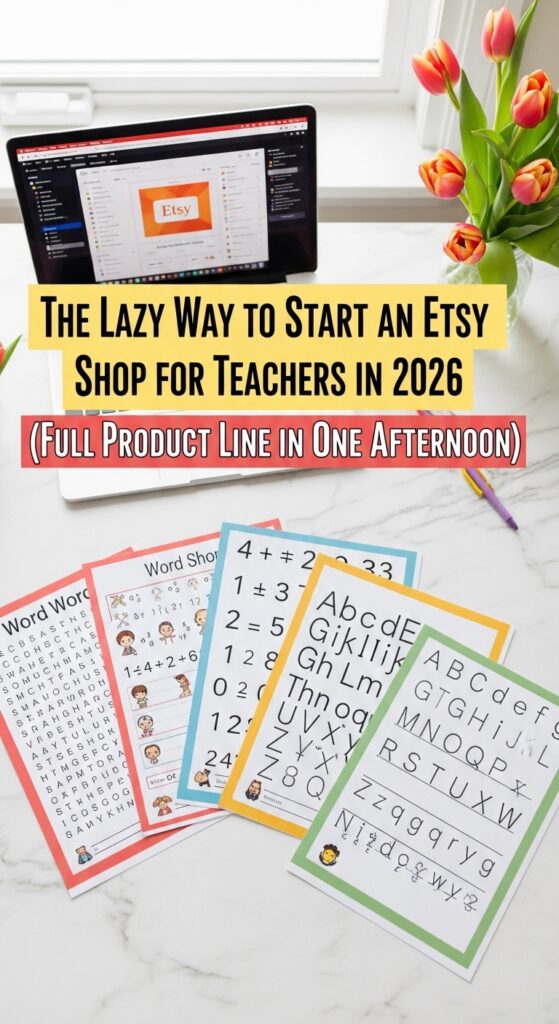
- Word search puzzles — themed by season, holiday, subject, or grade level
- Reading comprehension activities — short passages with question sets
- Alphabet and phonics sheets — huge demand in the homeschool community
- Crossword puzzles — especially subject-themed ones for middle grades
- Holiday-themed activity packs — Christmas math, Halloween spelling, Valentine’s Day reading
- Summer learning packets — a seasonal goldmine every May through July
The reason this works so well as a beginner strategy is that you don’t need to reinvent the wheel. You need to make your version of things that already sell — which is much, much easier.
The real key is volume. One worksheet listing might make $15 a month. Ten? You’re looking at $150+. Thirty listings? That’s where the $500–$1,000/month shops start appearing. The math is simple — the challenge is just getting the products made without burning yourself out doing it.
The “Single Afternoon” Product Line Strategy
Here’s the actual lazy-genius approach: instead of building each worksheet from scratch, you start with a generator.
A worksheet generator is essentially a ready-to-use content creation tool — you put in the parameters (grade level, topic, difficulty, theme), and it produces a complete, formatted worksheet you can brand and sell. No Canva wrestling. No “does this font look childish enough?” spiraling. Just clean, usable content ready to be made yours.
This is the approach that turns a single afternoon into a 10-to-20 product launch.
Here’s what a realistic afternoon looks like with this method:
Step 1: Pick your niches (15 minutes) Decide on 2–3 subject areas. Think: math + word search + alphabet activities. These three alone cover kindergarten through fifth grade across multiple learning styles — that’s a broad buyer pool from day one.
Step 2: Generate your worksheet content (45–60 minutes) Use your generator to create multiple variations. A math worksheet generator might give you addition sheets for grades 1, 2, and 3 — that’s already three separate listings from one tool. Vary the difficulty, vary the theme (back to school, winter, spring), and you’re multiplying your inventory fast.
Step 3: Lightly brand each one (30–45 minutes) Add your shop name, a simple color palette, and a font you love. You don’t need to redesign the worksheet — just make it feel like yours. A header, a footer, maybe a small logo. Ten minutes per worksheet max.
Step 4: Write your listings (45–60 minutes) This is where most people slow down — but if you batch it, it moves faster. Write one really good listing description and use it as a template for the rest, swapping out the specifics.
Step 5: Upload and go live (30 minutes) Add your PDFs, set your price ($2–$5 for individual worksheets, $8–$15 for bundles), and publish.
Honestly? Start to finish, that’s under four hours for your first real product line. ✨
The Worksheet Generator Kit That Makes This Whole Thing Possible
Okay — I have to tell you about this because it’s genuinely the thing that makes the single-afternoon strategy actually work.
There’s a set of 10 kids’ educational activity worksheet generators that covers the exact product types that sell consistently on Etsy: math problems, word searches, crosswords, alphabet activities, and more. Each generator is built specifically for creating printable content — meaning the output is already formatted, already clean, and already designed for the kind of buyer browsing Etsy at 9pm trying to find something for their kid’s homework packet.
What makes this particularly smart for a new Etsy seller is the breadth. Ten generators means ten different product categories you can launch from — which means you’re not putting all your eggs in one basket, and you’re not competing in just one search result either. You’re spread across the board.
Grab the 10 Worksheet Generator Starter Kit here — this is genuinely the starting point I’d recommend if you want to launch fast without starting from zero.
The way I’d use these: start with two or three generators, create 3–5 variations of each, and list them individually and as a bundle. That’s already 10–15 listings from your very first afternoon. Price the individuals at $2.50–$3.50, bundle them at $9.99, and you’ve got a shop that looks established even if you only just started.
✨ FRIEND TIP: When you first launch, aim for at least 10 active listings before you start promoting. Etsy’s algorithm tends to favor shops that look active and stocked — a sparse shop with two listings doesn’t signal “serious seller” the way a shop with 15 listings does. Use your worksheet generators to hit that number quickly, even if a few listings are just variations of the same base content.
How to Name, Price, and List Your Worksheets So They Actually Get Found
Creating the worksheets is the fun part. Getting them found is where a little strategy goes a long way.
Naming Your Listings for Etsy Search
Etsy is essentially a search engine. Your listing title is your SEO. Here’s a simple formula that works:
[Grade Level] + [Subject/Activity Type] + [Theme or Season] + Printable Worksheet
For example:
- 2nd Grade Subtraction Practice Worksheets — Spring Theme — Printable PDF
- Kindergarten Word Search Bundle — Animals — Printable Classroom Activity
- 3rd Grade Multiplication Facts Worksheets — Back to School — Printable Math Practice
These title structures naturally include the keywords parents and teachers are actually searching for. Don’t overthink it — just be specific and descriptive.
Pricing That Doesn’t Undervalue Your Work
Ngl, a lot of new Etsy sellers price too low out of nerves. Here’s a realistic pricing guide:
- Single worksheet (1 page): $2–$3
- Worksheet with answer key: $3–$4
- Mini pack (3–5 worksheets on one topic): $5–$8
- Full bundle (10+ worksheets): $10–$18
- Seasonal mega pack: $15–$25
You can always adjust later. Start in the middle of these ranges and see what converts.
Writing Descriptions That Convert
Your description should answer three questions: What is this? Who is it for? What do they get? That’s it. Keep it conversational and parent-friendly. Include grade level, number of pages, whether an answer key is included, and how they’ll access the download.
✨ FRIEND TIP: Add three to five product preview images to every listing — not just one. Show the cover page, a sample worksheet page, a mockup of it printed and on a table, and an example answer key. Listings with multiple quality images consistently outperform single-image listings. Buyers want to see exactly what they’re getting before they click “purchase.”
Getting Your First Sales: Pinterest Is Your Secret Weapon
Here’s something most new Etsy sellers don’t realize until they’ve been stuck at zero views for weeks: Etsy’s internal search alone won’t be enough at the start. You need traffic coming in from outside the platform too — and Pinterest is, hands down, the best free traffic source for digital teacher products.
Pinterest users are planners. They’re saving ideas for next semester, pinning resources for their homeschool co-op, curating activities for the summer. They’re exactly your buyer — and they shop slowly, meaning a pin you create today could bring in sales six months from now.
The way to win on Pinterest as a new shop:
- Create 3–5 pins per listing — different designs, different angles, same link
- Use keyword-rich pin descriptions — include grade level, subject, and “Etsy printable”
- Pin consistently — 5–10 new pins per day sounds like a lot, but with the right tools, it takes minutes
- Join group boards in the teacher/homeschool niche — this multiplies your reach without requiring a big following
If you want to take the Pinterest piece seriously without spending hours on it, PinCraft AI is genuinely worth exploring. It’s a tool that generates Pinterest titles, SEO descriptions, and image prompts for your Etsy listings in batches — so instead of writing 20 unique pin descriptions by hand, you upload your listings and it handles the copy. It even tracks your URLs so you’re not accidentally re-pinning the same link too often (which can get you flagged). For a new Etsy shop trying to gain traction fast, that kind of time-saving is real.
What This Could Actually Look Like for You
Let me paint a picture — not a hype picture, just an honest one based on what’s actually happening in this space right now.
A teacher creates her first Etsy shop on a Saturday afternoon using a set of worksheet generators. She lists 15 products by Sunday evening. By the end of week one, she has 3 sales. Nothing huge — maybe $12 total. But she also has reviews coming, Etsy’s algorithm starting to notice her, and a Pinterest account she’s been populating with pins.
By month three, she’s at 45 listings. She’s added holiday bundles and subject-specific packs. Her monthly revenue is around $180–$250 — mostly passive, mostly from pins she made weeks ago, and almost entirely from products she created in a handful of focused afternoons.
By six months in, some sellers in this niche are clearing $500–$800/month from their worksheet shops. That’s not retire-on-the-beach money — but it’s a mortgage payment, a grocery bill, a credit card cleared every month. From something you built in your spare time from content you were already an expert in.
The worksheet generators are honestly where this whole thing becomes doable. They remove the blank-page problem, which is the biggest barrier between “thinking about it” and “actually doing it.” The 10-generator kit I mentioned earlier is the starting point I’d go back to if I were launching fresh today — it covers enough product types to build a real, varied shop without having to source tools from twenty different places.
✨ FRIEND TIP: Don’t wait until everything is “perfect” to open your shop. The algorithm rewards activity — new listings, new reviews, consistent updating. An imperfect shop that’s live beats a perfect shop that never launches. Set a goal: 10 listings by Sunday. That’s it. Just 10. You can always add more next week.
Wrapping Up — You Know More Than You Think
If you’ve made it here, you now have a clearer picture of what actually goes into a profitable teacher Etsy shop — and more importantly, how doable this really is when you have the right starting tools.
Here’s a quick recap of what we covered:
- Worksheet printables are a high-demand, low-competition entry point for new Etsy sellers — especially for teachers who already understand the audience
- The single-afternoon strategy works when you start with generators instead of blank pages — it’s the difference between launching and stalling
- Volume and variety matter — aim for 10+ listings early, spread across subjects and grade levels, with individual items and bundles both listed
- Pinterest is your best free traffic source — pin consistently, keyword-rich, and let the long-game traffic roll in
You don’t need to be a designer. You don’t need to be a tech person. You just need to start, and you need the right tools in your corner when you do.
Whenever you’re ready to take that first step — the 10 Worksheet Generator Starter Kit is a genuinely solid place to begin. It’s the kind of thing that turns “I’ve been meaning to do this” into “I just listed my tenth product.”
Go build something. You’ve got this. ✨
❓ Frequently Asked Questions
Q1: How much does it cost to start an Etsy shop for teachers? A: Starting an Etsy shop is pretty affordable — Etsy charges $0.20 per listing, and there’s no monthly fee unless you upgrade to Etsy Plus. Your biggest upfront investment is your product creation tools, which is exactly why starting with a worksheet generator kit makes financial sense. You could realistically launch with under $50 total.
Q2: How do I create educational worksheets to sell on Etsy without design experience? A: Worksheet generators are the most beginner-friendly option — they produce formatted, ready-to-customize content without you needing any design background. Once generated, you can do light branding in Canva (free version works fine) by adding a header, your shop name, and a consistent color scheme. No design degree required.
Q3: Is selling worksheets on Etsy worth it for beginners in 2026? A: Honestly? Yes — especially if you approach it with a volume mindset from the start. Single listings make modest income, but a shop with 30–50 listings across multiple subject areas and grade levels can realistically bring in $300–$800/month in passive income once it gains traction. The key is consistency in listing and marketing, not overnight viral success.
Q4: What’s the difference between selling worksheets on Etsy vs. Teachers Pay Teachers? A: Both platforms have merit. Teachers Pay Teachers (TpT) has a highly specific educator audience and strong built-in search, but it’s also more saturated in certain niches. Etsy has a broader buyer pool (parents, homeschool families, tutors) and stronger Pinterest integration. Many successful sellers list on both — there’s no rule against it, and diversifying your sales channels is genuinely smart.
Q5: How long does it take to make money from an Etsy teacher shop? A: Most shops see their first sale within 2–4 weeks if they’re actively listing and driving Pinterest traffic. Reaching consistent monthly income (think $100–$300/month) typically takes 3–6 months of steady effort. It’s not instant — but it’s also not years. The teachers who grow fastest are the ones who launch quickly with a solid starter set of listings rather than waiting until everything is “perfect.”
Try PinCraft AI Free Today
Design beautiful Pinterest pins in seconds with AI. Start your free trial — no credit card needed.

Helping creators use AI tools and Pinterest to build digital product income from home.