

Okay so here’s a scene for you. You’re scrolling Pinterest at 11pm, you fall into a junk journal rabbit hole, and forty minutes later you have seventeen tabs open and a very specific thought: people actually get paid for this?
Yes. They do. I’ve watched sellers go from “this is just something I do to relax” to genuinely replacing a chunk of their monthly income, and it usually starts smaller and messier than you’d think — not with a perfect Etsy shop, just one journal and a willingness to hit publish.
If you’ve been making junk journals for yourself and wondering whether anyone would actually pay for one, that question is basically the whole reason I’m writing this. We’re going to walk through what actually sells, how to price it without guessing, where to list it, and the exact thing I wish someone had told me before my first sale.
Just so you know — some links in this post are affiliate links. If you grab something through my link, I may earn a small commission at no extra cost to you. I only ever share things I genuinely use or love. ✨
The part nobody tells you about starting
Here’s the thing that trips up almost every beginner — you don’t need a hundred journals to sell one. You need one good one. If you’ve been putting this off because you don’t have a “collection” yet, you’re honestly not alone in that.
Most people who never sell their first journal aren’t failing at the craft. They’re stuck in prep mode — reorganizing supplies, watching fifteen more tutorials, telling themselves they’ll list something “once it’s better.” Sound familiar?
But what if it didn’t have to be that complicated? The sellers who actually make money aren’t the most talented ones. They’re the ones who listed something imperfect and let real buyers tell them what to improve.
What actually sells (this matters more than talent)
Buyers aren’t paying for perfection — they’re paying for a feeling. A journal that looks lived-in, layered, and a little nostalgic will outsell a technically flawless one almost every time.
A few patterns I’ve noticed across the best-performing shops:
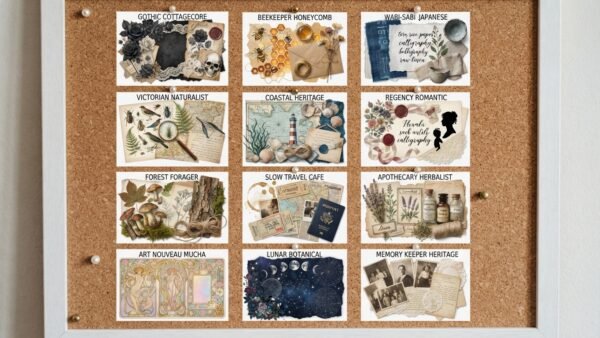
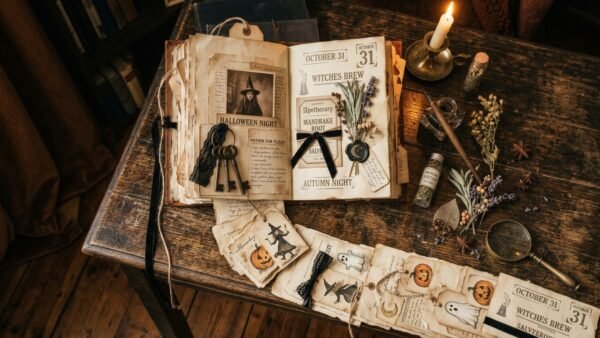
- Themed journals sell faster than random ones — cottagecore, travel, witchy/vintage apothecary, and coastal grandma themes consistently do well
- Pre-filled “starter” journals (with pockets, tags, and a few pages already decorated) sell better than blank ones
- Bundles beat singles — pairing a small journal with loose ephemera packs raises your average order
- Video listings outperform photo-only listings — a 15-second flip-through gets noticeably more saves and clicks. Video pins are getting roughly four times the traction of a standard photo pin right now, so if you only change one thing this month, film your flip-through.
Pricing it without guessing (a simple formula)
A junk journal is priced fairly at materials cost plus your hourly rate, times the hours it took to make. That’s the honest starting formula, and it feels a lot less scary once it’s written down.
- Add up your materials — most beginner journals run $4–$9
- Track your actual time, start to finish
- Pick a rate you’d be okay with — even $12–$15/hour is reasonable
- Add materials + (hours × rate), then round up
So a journal that costs $6 in materials and takes 2 hours at $15/hour comes out to $36. Most beginner sellers land somewhere in the $18–$35 range.
Don’t undercharge just to make a sale. A $12 journal that took three hours isn’t a bargain for anyone — it’s just underpaid labor.
Where to actually sell them
Etsy is still the easiest starting point because buyers are already there, actively searching “junk journal for sale.” Pinterest is where you drive traffic to that Etsy listing — think discovery engine, not storefront.
Getting your Pinterest pins to actually convert
This is where a lot of sellers lose momentum — they make a beautiful journal, take one photo, pin it, and wait. That’s the awareness step, not the sale.
I’m not going to pretend making scroll-stopping pins for every listing doesn’t eat up time, because it does. This is honestly the one thing I wish I’d found sooner: I started running my listings through PinCraft AI’s Mockup Studio to turn a plain flat-lay photo into a styled, seasonal pin with the headline already layered on. Cut my pin-creation time to a few minutes per listing.
Coming up with ideas when you’re staring at a blank page
If the actual journal-making is the fun part and the “what do I even put in it” part is where you freeze — that’s normal, and it’s the number one thing that stalls sellers before their first listing.
I use my own Junk Journal Prompt Generator when I’m out of ideas, and it spits out themed page prompts, layout ideas, and ephemera pairings so I’m not staring at a blank spread wondering what goes where. No rush trying it — it’ll be there whenever you’re ready.
What it actually looks like once it’s working
Picture this — it’s a random Tuesday, you’re making dinner, and your phone buzzes with an Etsy sale notification for a journal you listed two weeks ago and mostly forgot about. That’s genuinely how it starts feeling once you’ve got a handful of listings up and a couple pins doing their quiet work in the background.
Some sellers making journals part-time are pulling in $150–$400 a month once they’ve got 8–10 listings live and a steady pin rhythm going. That’s not overnight-riches territory — but it’s real, steady, “this actually helps with groceries” kind of money.
You’ve got everything you need to start
You now know what actually sells, how to price it so you’re not shortchanging yourself, where to list it, and how to get eyes on it without burning a whole weekend on pin design.
Quick recap:
- Start with one good journal, not a whole collection
- Price by materials + your time, not by guessing
- Film a flip-through video — it’s outperforming photo-only pins right now
Whenever you’re ready to make your first listing, that’s honestly the only step that matters. And if you want a hand with the idea part, my Junk Journal Prompt Generator is right there for you, no pressure either way. 🤎
Frequently Asked Questions
Do I need expensive supplies to start selling junk journals?
No — most beginner journals cost $4–$9 in materials using scrap paper, dollar-store ephemera, and basic binding supplies. You can upgrade later once you know what sells.
How do I price a junk journal I made myself?
Add your materials cost to your hours worked multiplied by a fair hourly rate, then round up. Most beginners land between $18 and $35 per journal.
Is it actually worth it for a beginner, or is the market too saturated?
It’s worth it if you treat it like a real listing, not a one-off. Most listings that don’t sell are missing a video or a clear theme, not competing against oversaturation.
Should I sell on Etsy or Pinterest?
Sell on Etsy — that’s where buyers are already looking to purchase. Use Pinterest to drive traffic to your Etsy listings.
How long does it take to see a first sale?
Many sellers get their first sale within 2–4 weeks of listing, especially with a video flip-through and a Pinterest pin driving traffic.
Try PinCraft AI Free Today
Design beautiful Pinterest pins in seconds with AI. Start your free trial — no credit card needed.

Helping creators use AI tools and Pinterest to build digital product income from home.
This article really covers the details I wasn’t sure about.
Is it safe to use the scrapbooking paper bought from vendors, or is that a copyright issue? For example using Stamperia Paper Pads.
Hi Machelle,
Thanks for reaching out!
Using original, physical paper pads (like Stamperia) directly in your physical crafts or junk journals is totally fine—that is protected under the First Sale Doctrine and standard Angel Policies.
Where you run into copyright issues is if you **scan, digitize, or photocopy** the sheets to re-sell as printables or physical copies.
As long as you’re using the physical pages you bought and giving credit to the brand on your finished product, you are good to go!