
Just so you know — some links in this post are affiliate links. I may earn a small commission at no extra cost to you. ✨
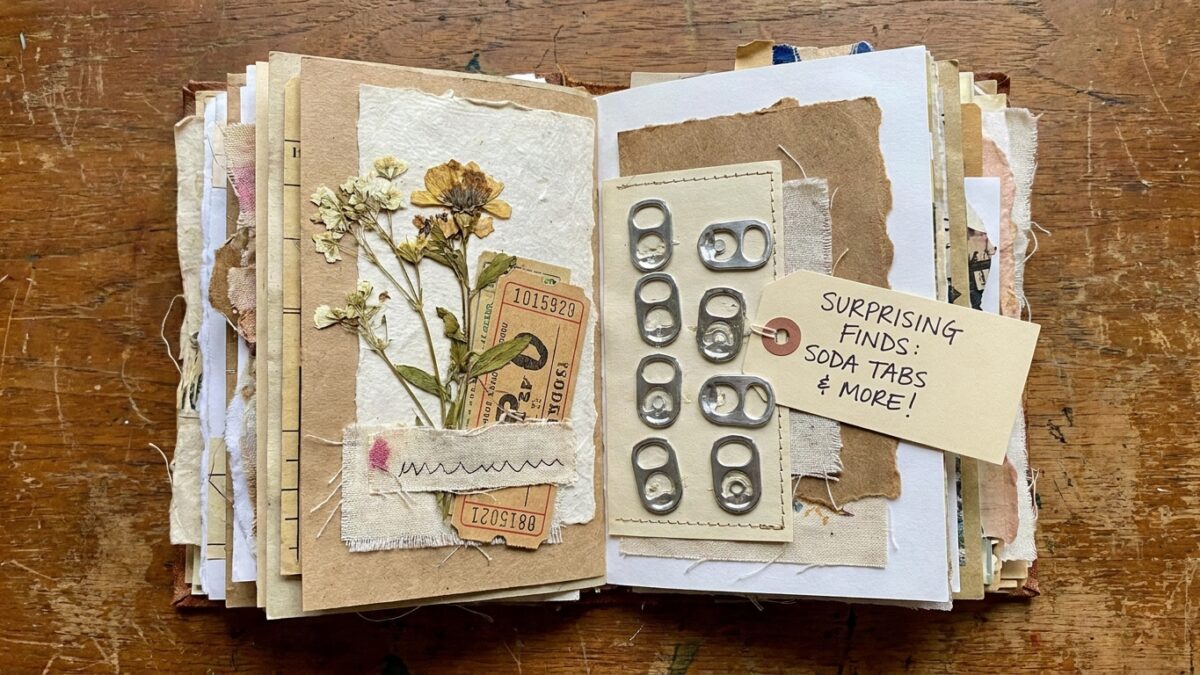
One of the most freeing things about junk journaling is that almost anything becomes a beautiful page element if you know how to style it.
Some of the most-saved pages on Pinterest aren’t made from expensive craft supplies. They’re made from things most people throw away every single day. And the results make people stop scrolling and save the pin every time.
📸 AI Image Prompt — Featured image
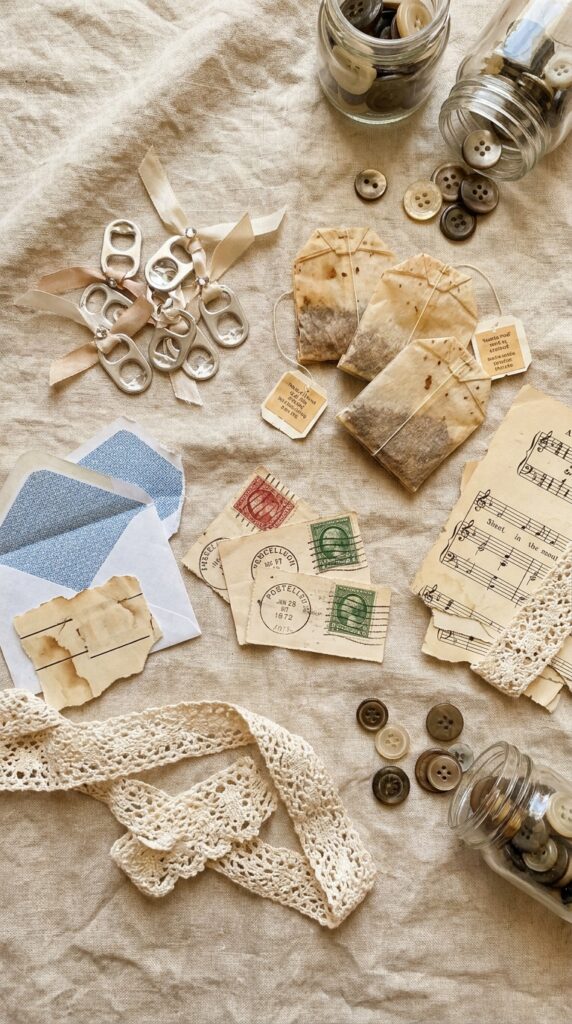
Pinterest flat lay of everyday found objects transformed into junk journal embellishments: soda can tabs with ribbon and gems, dried tea bags, security envelope liners showing geometric patterns, cancelled stamps, sheet music fragments, lace trim, vintage buttons — arranged artfully on aged linen, warm vintage tones
Why ‘junk’ is literally the whole point
Junk journaling started as a way to honour the beauty in discarded things. To slow down, look at something about to be thrown away, and ask: what could this become?
That philosophy is what makes junk journal pages feel genuinely individual. You cannot exactly replicate someone else’s journal because you don’t have exactly the same junk. Every page is one of a kind — and that’s what people pay for.
📊 Listings with a strong found-object and layered ephemera aesthetic average 5.4% conversion on Etsy — more than double the platform average. The highest-converting listing in current market data converts at 13.38%.
Soda can tabs — yes, really
📸 AI Image Prompt — Featured image
three soda can tabs decorated with fabric ribbon bows and flat-back crystal gems through the holes, on aged parchment paper with lace trim, pressed dried flowers, and vintage pearl buttons — cottagecore vintage styling, warm soft tones, close-up detail photography
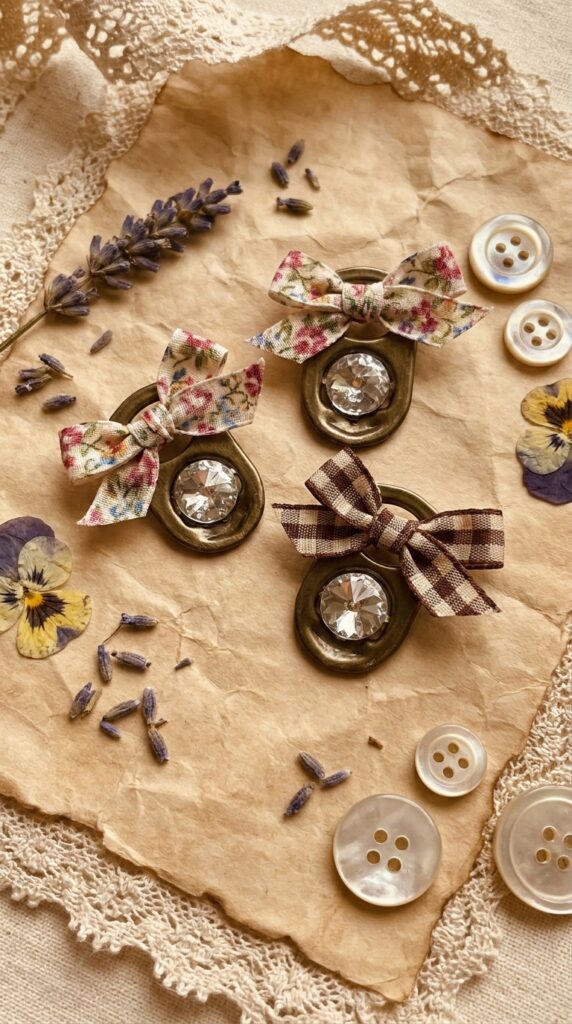
Soda can tabs — the aluminium rings you pull off drinks — transform completely when you add a small flat-back gem, a fabric bow, or a pearl button through the hole.
Pair them with soft vintage materials — linen, pearl buttons, floral ribbon, dried lavender — and the aluminium stops reading as trash and starts reading as “industrial chic.” In practice they work as embellishments on pocket pages, page dividers on binding rings, or decorative clasps on folder-style pockets. Self-adhesive flat-back gems in assorted sizes are the most useful accessory for this.
From your recycling bin
- Soda can tabs — with fabric bow and small gem through the hole (see above)
- Grey cardboard packaging — inner board from cereal boxes makes beautiful aged-paper style covers
- Tea bags — dried and pressed flat, they genuinely look like aged parchment. Unfold after drying for a larger piece.
- Coffee filters — stain with cold tea or coffee first for instant aged, organic texture. Crumple while damp, flatten to dry.
- Candy wrappers — foil wrappers add metallic shimmer to collage backgrounds
- Brown paper bags — torn into irregular pieces, beautiful as kraft texture layers
- Security envelope liners — the printed geometric or wave patterns inside bank envelopes are stunning as background paper. Start saving these now.
From your sewing box
📸 AI Image Prompt — Featured image
junk journal pocket page decorated with mixed vintage buttons in cream and blush tones, white lace trim edging, pale pink silk ribbon tie, aged cream paper background — close-up detail, shabby chic aesthetic, soft natural light
- Ribbon scraps — any length, any pattern. Borders, ties, woven elements, or layered across a page.
- Buttons — sewn or glued onto covers, pocket edges, ephemera sheets. Mixed vintage-style button packs are one of the most useful junk journal investments.
- Lace trim — even 2cm along one edge transforms a page entirely
- Fabric scraps — torn into irregular strips as background texture layers
- Safety pins — vintage brass safety pins look beautiful on covers and pocket edges
- Thread and yarn — wrapped around pages, used as binding, or laid as a design element
From your kitchen
- Dried flowers and herbs — pressed flat as botanical page elements. Lavender, chamomile, rose petals, pansy faces all press beautifully.
- Onion skins — translucent and paper-thin, they layer over text pages beautifully
- Cinnamon sticks — tied in small bundles as page dividers or decorative ephemera
- Bay leaves — dried and pressed, lovely botanical accents with an elegant oval shape
- Coffee grounds mixed to paste — painted onto paper and dried for instant aged, gritty texture
From your bookshelf
- Old book pages — from worn paperbacks you own that are beyond reading. Dense dictionary or encyclopaedia pages are especially popular.
- Old atlas pages — vintage map pages are among the most loved junk journal backgrounds ever
- Music sheets — from old hymnals or piano books. Musical notation as background layer is one of the most Pinterest-saved junk journal elements.
- Old magazine pages — the older the better. 1960s–1980s home and garden magazines are especially prized.
From your stationery drawer
- Cancelled postage stamps — from old letters. The junk journal community is passionate about these. International stamps especially.
- Envelope flaps — patterned envelope interiors make instant pocket pages
- Old receipts and tickets — train tickets, cinema stubs, printed receipts with distinctive typography
- Wax seal stamps — creates faux-antique letter seals on pages. A starter wax seal kit is one of the most versatile junk journal investments.
- Rubber stamp prints — stamped on aged paper, these look genuinely Victorian
Three rules for making found objects look intentional
Colour cohesion. All materials should share a colour temperature — warm sepia and amber together, or cool blue-grey and slate together. Never mix warm and cool on the same page.
Scale balance. One large element, two medium, several small details. Avoid pages with only small scrappy pieces — it reads as chaotic rather than layered.
Negative space. Leave background visible. Good junk journal pages breathe. The background is part of the design.
Recreating this in digital kits
📸 AI Image Prompt — Featured image
AI-generated digital junk journal page with authentic found-object quality: torn paper edges, vintage text fragments, pressed botanical overlay, fabric texture background, wax seal detail, aged foxing spots — looks hand-assembled but AI-created, warm sepia palette, high detail
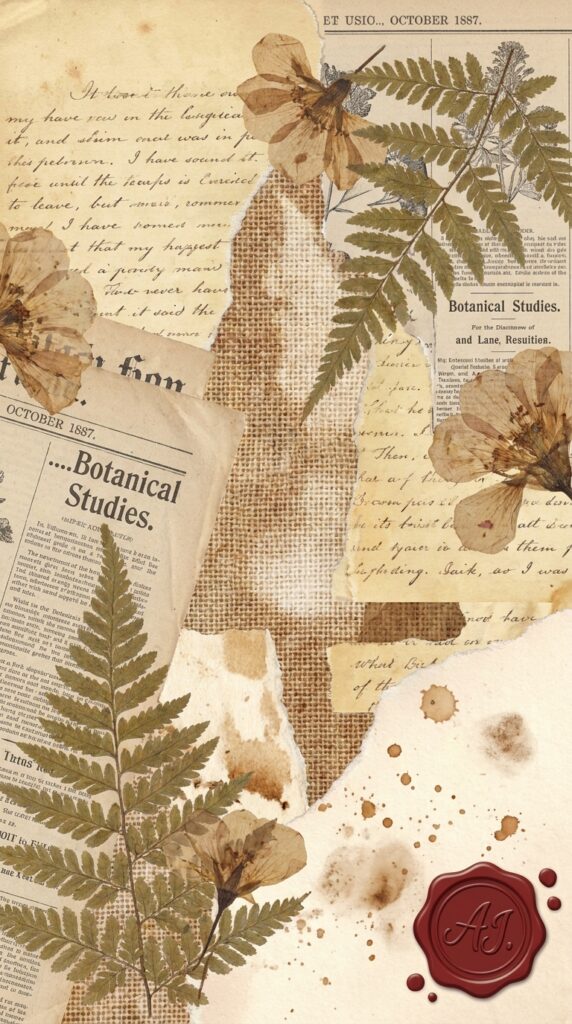
If you’re creating digital kits to sell on Etsy or your own platform, the found-object aesthetic is entirely achievable in AI. The key is prompt language that asks for torn edges, layered textures, and imperfect accumulated qualities rather than clean illustration.
The Junk Journal Prompt Generator has element settings specifically for this — torn paper edges, layered ephemera, fabric texture overlays — across any theme. This is what gets pages that look hand-assembled rather than digitally created.
Once your kit is ready, PinCraft AI creates Pinterest pins for each page in a few clicks — pin graphic, title, description, and keywords. The Pinterest Viral Blueprint is free to download and covers the strategy that builds real reach without paid ads.
Frequently asked questions
What household items can I use for junk journaling?
Almost anything with interesting texture or visual quality. Tea bags dried and pressed look like aged parchment. Coffee filters stained with tea create organic aged paper. Security envelope liners have beautiful geometric patterns. Brown paper bags torn irregularly make excellent kraft texture layers. Old book pages, sheet music, magazine pages, cancelled stamps, and ribbon scraps all work beautifully.
Are soda can tabs really used in junk journals?
Yes, and they’re one of the most popular embellishments once you see them done right. The key is pairing the aluminium tab with soft vintage materials — fabric bows, flat-back gems, pearl buttons. The contrast between hard metal and soft textile is what makes them work. Most commonly used on pocket pages, as page dividers, or as decorative clasps on folder-style pages.
What is the best paper for printing junk journal pages at home?
80–90gsm matte cardstock gives the best results. For background papers and ephemera sheets, standard 80gsm is fine. For pocket pages that need to hold a fold, 90gsm is better. Avoid glossy paper — the matte surface looks more authentic and takes ink more naturally.
Can I make money from junk journaling?
Yes. Digital junk journal kits on Etsy average around 57 sales per month across active listings, with top sellers generating $3,000–$4,000+ monthly from single products. Selling on your own platform (Gumroad, Payhip, or a Hostinger website) gives higher margins since you avoid Etsy’s 6.5% transaction fee.
Do I need special tools to start junk journaling?
No special tools needed. The basic physical kit is scissors, a bone folder, PVA glue, and binder rings. For digital kits, you need an AI image tool and Canva for formatting. That’s everything.
Try PinCraft AI Free Today
Design beautiful Pinterest pins in seconds with AI. Start your free trial — no credit card needed.

Helping creators use AI tools and Pinterest to build digital product income from home.
🖼🎨🌸🌼🦋🐦🐈💛☕️🍽
I have been making Junk Journals usually for covering Composition Notebooks 📓 and other things like reusing old or new Cards,for small Journals.
I have some interesting books for Junk Journaling for learning and tips.
I watch alot of YouTube tutorials .
I wish that I could find you on YouTube.
Thank you,
Jody