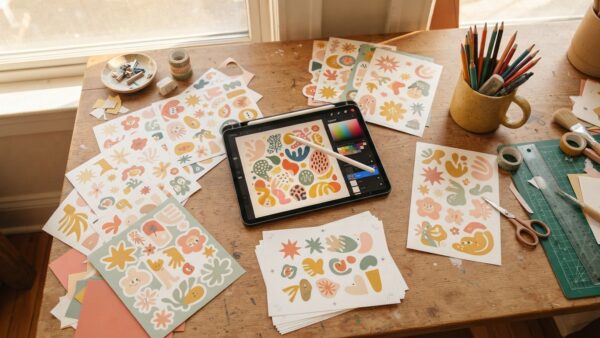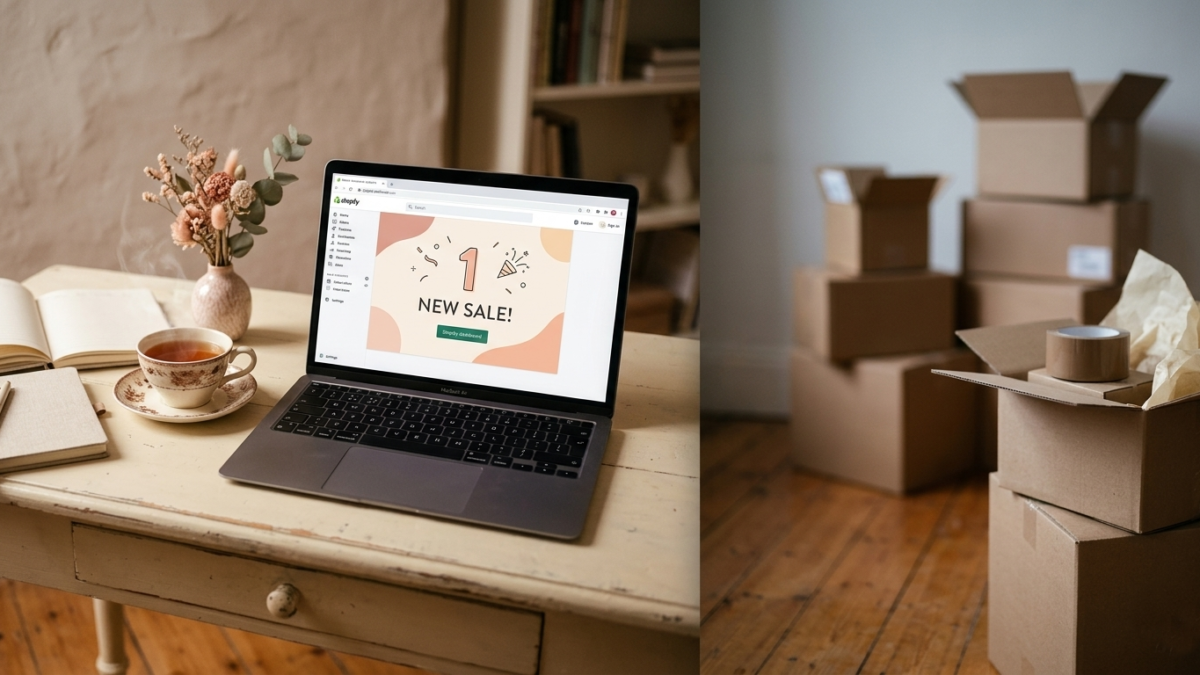
I know what it feels like to load a car with boxes on a Saturday morning, haul everything to the flea market, spend five hours selling in the heat, pack up whatever didn’t move, and come home with a few hundred dollars and a level of exhaustion that took two days to recover from. That’s physical selling. It works. The money is real. But it requires you — every single time — in a way that scales only as far as your physical presence does.
Digital products are the version of selling that doesn’t work that way. And once you’ve experienced both, the comparison isn’t really close. Here’s the honest breakdown.
Some links here are affiliate links — I may earn a small commission at no extra cost to you. ✨
The Moment I Understood the Difference
I made thousands selling kids’ clothes at the flea market. Saturdays, every week, early mornings, loading the car the night before. The income was consistent and the feedback was immediate — hand over the item, receive the cash. It felt like real business because it was. But it was also deeply, physically tied to me being there. Sick Saturday? No income. Family thing? No income. Just didn’t feel like it? No income.
The first time I made a sale from a digital product while I was doing something else entirely, I genuinely sat with it for a minute. Someone found something I made, decided it was worth paying for, paid for it, downloaded it, and the whole transaction completed without me touching anything. That’s a fundamentally different kind of income — and once you’ve felt that difference, physical selling looks completely different.
1. No Inventory, No Storage, No Restocking
Physical products need to live somewhere before they’re sold. That means storage space, organization systems, and the ongoing task of managing what you have and what you’ve run out of. For sellers working from home, this often means a corner of the garage, a spare room, or a closet slowly filling with stock.
Digital products exist as files on a server. They take up no physical space. They never run out. A digital planner can sell a thousand times and the “inventory” is exactly the same as it was after the first sale. That’s not a minor efficiency — it’s a structural difference in what you’re managing.
2. No Shipping, No Post Office, No Waiting
Shipping physical products means packaging materials, printed labels, trips to the post office, tracking numbers, and the occasional lost or damaged shipment that requires you to manage an unhappy customer. That’s before you consider the environmental cost or the time cost at scale.
A digital product delivers itself. The moment a buyer completes checkout, the file is automatically sent. No action required on your part. No packaging. No label. No queue at the post office on a Tuesday afternoon. The buyer has their product in minutes — often faster than they’d get anything delivered by even the fastest shipping option.
3. The Math Is Fundamentally Different
Physical product margins are compressed by the cost of goods, packaging, shipping, and the time it takes to fulfill each order. A $15 item that cost $6 to source, $3 to ship, and $2 in packaging leaves $4 in margin — before your time.
A $7 digital product costs nothing to replicate. The margin on sale 1 and sale 1,000 is identical. Etsy takes approximately $1.10 in fees. You keep $5.90 — every time, regardless of volume. That math doesn’t change. It doesn’t get worse as you sell more. It scales flat.
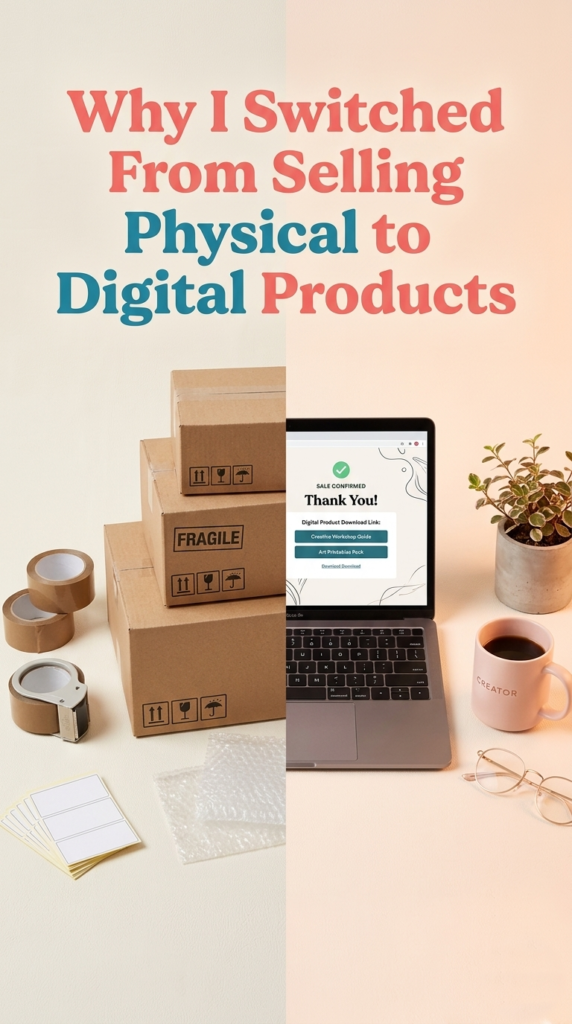
4. You Can Sleep Through a Sale
Physical selling requires presence — at a market, at a shop, at a computer fulfilling orders. Digital selling does not. A product listed on Etsy is visible and purchasable 24 hours a day, seven days a week, in every time zone simultaneously. While you’re sleeping, while you’re at the beach, while you’re managing a flea market table, the digital shop is open.
This isn’t abstract. It’s a phone notification at 2am that someone in a different country just bought your planner. It’s checking your sales dashboard on a Monday morning and seeing that six transactions happened over the weekend while you were offline. That’s the version of selling that physical products structurally cannot replicate.
5. One Product, Unlimited Sales
This is the core structural advantage that everything else flows from. A physical product sells once and leaves your inventory. A digital product sells indefinitely. Create it once. Optimize the listing once. And then it generates revenue on its own timeline.
That doesn’t mean passive in the sense of zero effort forever — you’ll update listings, create new products, improve your marketing. But the product itself doesn’t need to be recreated. It doesn’t wear out. It doesn’t expire. It doesn’t go out of stock. Those are not small things.
Where Physical Products Still Win
Honest answer: physical products win when the tactile experience is the point. Handmade jewelry, baked goods, vintage clothing, custom pottery — these have qualities that can’t be digitized and buyers who specifically want the physical object. The flea market made me thousands of dollars and I’m genuinely glad I did it. It taught me pricing, buyer psychology, and what moves.
But if you’re building income you want to scale — income that doesn’t require Saturday mornings in the heat or a spare room full of stock — digital products are the better structure. Not because they’re easier (creating good digital products requires real effort), but because the work you put in doesn’t reset after every transaction.

Frequently Asked Questions
Are digital products really more profitable than physical products?
For home-based sellers, yes — particularly over time. The margin per unit is typically higher because there are no physical production costs, and the same product can sell indefinitely without additional investment. The income also doesn’t require your physical presence for each transaction, which changes how your time relates to your revenue.
What are the downsides of selling digital products?
They take time to create well, they require optimization and marketing to be found, and they don’t have the immediate cash feedback loop of a face-to-face sale. There’s also a longer ramp-up period — physical sellers can make money on day one; digital product shops typically take weeks to months to build consistent sales. The trade-off is that once the system is working, it continues working without proportional additional effort.
Can you make serious money from digital products?
Yes — sellers consistently generate $500 to several thousand dollars monthly from Etsy digital products alone. The range is wide because it depends on how many products you have, how well they’re optimized, and how much traffic you drive to your listings. Pinterest is one of the most effective free traffic sources for digital product sellers specifically.
Is it hard to transition from physical to digital selling?
The skills transfer more than you’d expect. Understanding what a buyer wants, how to price, how to present a product attractively — all of that carries over. The main difference is that instead of physical sourcing and logistics, your work is in creation, design, and listing optimization. For most sellers, that trade is a welcome one.
Try PinCraft AI Free Today
Design beautiful Pinterest pins in seconds with AI. Start your free trial — no credit card needed.

Helping creators use AI tools and Pinterest to build digital product income from home.