You can have the most beautifully designed printable on Etsy and never sell a single copy — if nobody can find it. Etsy is a search engine as much as it’s a marketplace. Buyers type something in, Etsy shows them results, and the listings that match their search most closely win the visibility. Writing your listings well isn’t optional SEO homework. It’s the difference between a product that sells and one that sits.
Here’s exactly how Etsy search works and what to do with that information.
Some links in this post are affiliate links — I may earn a small commission at no extra cost to you. ✨
How Etsy Search Actually Works
Etsy’s algorithm has two stages: query matching and ranking. In the first stage, Etsy looks at your title and tags to determine if your listing is relevant to what the buyer searched. In the second stage, it ranks all the relevant listings by factors including recency, reviews, conversion rate, and listing quality score.
You control stage one entirely through your title and tags. You influence stage two through your photos, pricing, reviews, and how often buyers click and purchase your listing. But none of stage two matters if you fail stage one — and most listings fail there because the title is too vague or the tags are too broad.
Writing Your Etsy Title
Your title should answer this question: what would a buyer type into Etsy to find exactly this product?
Start with your most specific, buyer-facing keyword phrase. Then add additional descriptive phrases separated by commas or dashes. Use your full 140-character limit — Etsy reads the whole thing.
Bad title: Kids Printable Pack
Better title: Summer Activity Pack for Kids Ages 6-9 — Printable Worksheets — Instant Download — Screen-Free Summer Activities
The better title answers: what is it (activity pack), who is it for (kids ages 6-9), what format (printable worksheets, instant download), and adds a related search phrase (screen-free summer activities). Each of those phrases is something a buyer might independently search.

Using Your 13 Tags Strategically
Etsy gives you 13 tags per listing. Each tag can be up to 20 characters. This is not a lot of space — which means single-word tags are almost always a waste. Nobody searches just “printable” — they search “summer printable for kids” or “printable planner instant download.”
Use every tag as a multi-word phrase that captures a different angle on the same product:
- Broad category: kids printable pack
- Specific use: summer activity sheets
- Age-specific: printables for kids ages 6 9
- Format: instant download pdf
- Occasion: summer break activities
- Problem: screen free kids activities
- Buyer intent: printable for busy moms
- Seasonal: summer learning printable
- Alternative search: kids worksheet printable
- Gift angle: gift for kids summer
- Descriptor: educational activity pack
- Platform: etsy digital download kids
- Related product: summer bucket list kids
The goal is to cover as many different search entry points as possible — all legitimately relevant to your one product.
Writing a Description That Converts
The listing description matters less for Etsy’s search algorithm than the title and tags — but it matters significantly for buyer conversion. Someone who finds your listing decides whether to buy based primarily on your photos and secondarily on your description.
A good description structure:
- First paragraph — Answer: what is this and who is it for? Be specific.
- Second paragraph — What’s included? List every page, sheet, or file in the download.
- Third paragraph — How does it work? Explain the download process for first-time digital buyers.
- Fourth paragraph — Any technical details: file format, dimensions, printing recommendations.
Put keywords naturally in your description — not stuffed, just used the way you’d naturally describe the product. This also helps with Etsy’s overall listing quality assessment.
Your Listing Photos Are Part of the SEO
Etsy’s algorithm includes listing quality in its ranking — which is influenced by how often people click your listing when they see it in search results. A great photo gets the click. A bad photo loses it even if your title and tags are perfect.
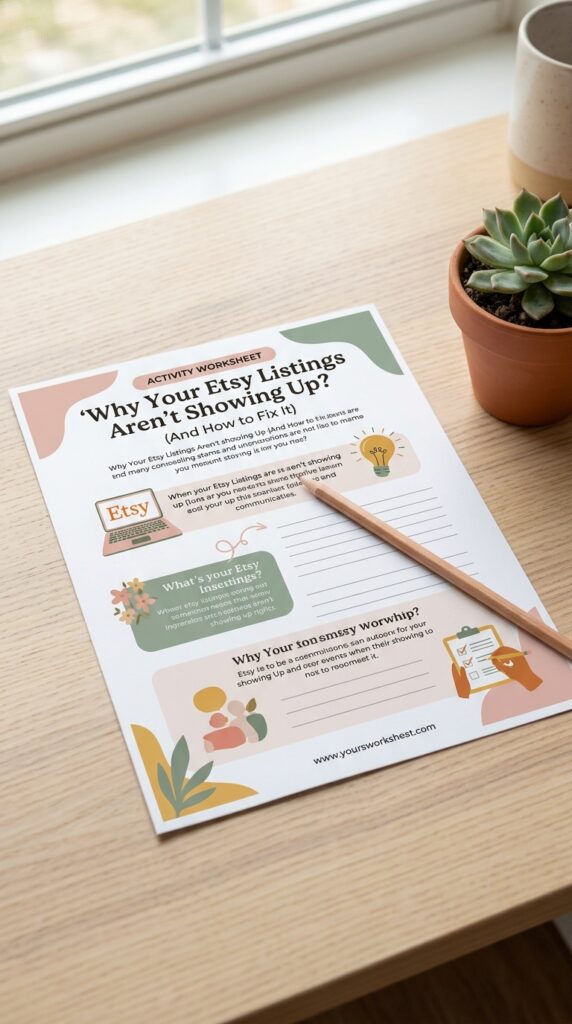
For digital products, you need mockup photos — your product shown in a realistic context. A planner page on a desk with a coffee cup. A worksheet printed and shown next to a pencil. These make the product feel real and tangible to buyers who can’t physically hold it before buying.
Watching Your Data and Improving
Etsy’s Shop Manager has a Stats section that shows you how buyers are finding your listings — specifically which search terms led to views and purchases. Check this monthly. The keywords buyers are actually using to find you are sometimes different from what you expected, and that information is genuinely valuable for updating your tags and creating new products.
If a listing has been live for 60 days with no sales and consistent views, the problem is usually photos or pricing. If it has no views, the problem is titles and tags. That distinction tells you exactly what to fix.
Want to see the full process of setting up an Etsy listing from scratch?
Frequently Asked Questions
How long does it take for an Etsy listing to show up in search?
New listings typically appear in Etsy search within 24 to 72 hours. However, ranking competitively — appearing on the first page of results for popular searches — takes longer and depends on your listing quality, reviews, and how the algorithm assesses your shop history over time. New shops with no reviews start lower in rankings and climb as they accumulate sales and positive feedback.
Should I use all 13 Etsy tags?
Yes, always. Every unused tag is a missed search opportunity. Even if you struggle to think of 13 relevant phrases, use all 13 with the most relevant options you can find. An irrelevant tag doesn’t hurt you; a missing tag means you’re invisible to buyers who would have found you through it.
Does Etsy SEO really make a difference?
It makes the difference between being found and not being found — which is the difference between selling and not selling. Two identical products with different title and tag strategies will get dramatically different traffic. This isn’t minor optimization. It’s foundational to whether your shop works.
Can I change my Etsy listing title and tags after publishing?
Yes, and you should update them based on performance data. Changing titles and tags on an existing listing temporarily resets some of its search history while Etsy re-evaluates it — so make changes thoughtfully rather than constantly. If something is working, don’t change it. If a listing has no views after 60 days, updating the title and tags is the right first step.
Try PinCraft AI Free Today
Design beautiful Pinterest pins in seconds with AI. Start your free trial — no credit card needed.

Helping creators use AI tools and Pinterest to build digital product income from home.