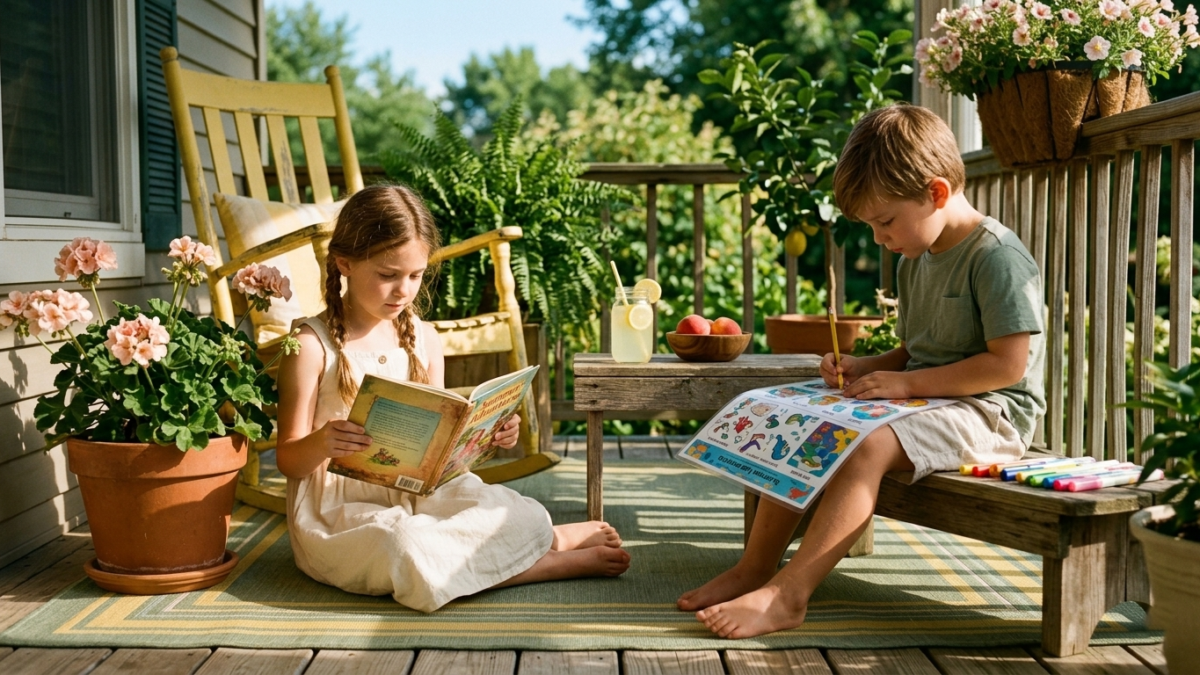
Summer learning sounds like it should be controversial — kids deserve a break, and the last thing most parents want to do is recreate the school day at home in July. But there’s a wide middle ground between “full school mode all summer” and “three months of screens and boredom.” And that middle ground is where the best summer activities live.
The research on summer learning loss is consistent: kids who have no mental engagement over the break fall behind. But the activities that prevent that don’t need to look anything like a classroom. They just need to use the brain in a way that keeps it active. Here’s what that looks like in practice.
Some links here are affiliate links — I may earn a small commission at no extra cost to you. ✨
What Summer Learning Loss Actually Means
Summer learning loss — sometimes called the “summer slide” — refers to the academic regression that happens when kids have no structured learning over the break. Studies consistently find that students lose one to two months of reading progress over summer, and the math slide can be even steeper for younger kids still building foundational skills.
The good news: preventing it doesn’t require much. Twenty to thirty minutes of reading per day is enough to maintain reading skills. A few math activities per week keeps number sense intact. The goal isn’t acceleration — it’s maintenance. And that’s genuinely achievable without turning summer into a second school year.
Reading Activities That Don’t Feel Like Homework
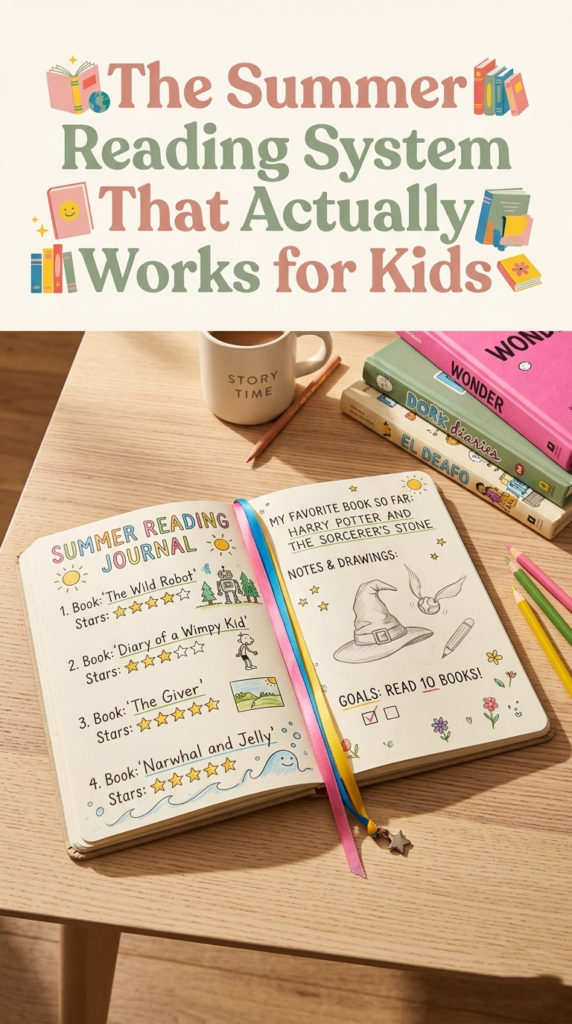
Summer reading challenge — Set a goal: 20 books by the end of August, or one book per week, or reading for 20 minutes every day. Make it visual — a paper chain where each link is a book completed, or a reading log they fill in themselves. Small rewards at milestones keep the momentum going. Most public libraries run their own summer reading programs with prizes — worth checking.
Book journal — A simple notebook where kids write two or three sentences about each book they finish. What happened, what they liked, what they’d change. This builds both reading comprehension and writing practice without feeling like either.
Audiobooks count — For reluctant readers especially, audiobooks engage the same comprehension muscles without the physical reading barrier. Library apps like Libby provide free audiobooks through your public library card. Good for long car rides, before-bed listening, and kids who process better through hearing than reading.
Math Activities That Feel Like Games
Cooking and baking — Measuring ingredients, doubling recipes, estimating cooking time, counting servings — this is applied math happening in real time. Kids who cook regularly maintain number sense over summer without a single worksheet. Assign them one meal or one baking project per week with increasing independence.
Money math — Give kids a small budget for something they care about — a trip to the store, a movie choice, a snack run — and let them manage it. Counting change, estimating totals, making decisions within a limit. This is financial literacy and arithmetic simultaneously.
Math printable packs — For kids who need more structured practice, a well-designed math printable pack can cover key skills without feeling like punishment. The best ones include games, puzzles, and visual activities alongside calculation practice — so it doesn’t feel like a worksheet dump. Age-appropriate difficulty is key: too easy and it’s boring, too hard and it’s discouraging.
Board games and card games — Cribbage, Yahtzee, Uno, Sequence — most games involve counting, probability, strategy, and pattern recognition. Family game nights are legitimate math practice dressed as fun. Classics like Monopoly add financial literacy, and games like Spot It build visual processing speed.
Creative and Writing Activities
Summer journal — One entry per day. Can be a sentence, a paragraph, a drawing with a caption, or a list of things that happened. The format doesn’t matter — the habit of daily writing does. By September, they’ll have a genuine record of their summer and writing that’s noticeably more fluent than June.
Creative writing prompts — Printed or written on strips of paper folded and drawn from a jar. “You wake up and the world has turned upside down.” “Write a story from the perspective of your pet.” “Describe your perfect day in 100 words.” These work especially well for kids who hate blank-page writing but engage readily with a starting point.
Pen pals — A cousin, a school friend who moved away, a grandparent. Real letter writing to a real person who writes back. Gives purpose to the writing and teaches the practical form of letter writing that schools rarely have time to cover properly.
Science and Exploration Activities
Nature journal — A notebook dedicated to outdoor observations. Kids record what they see — bugs, birds, plants, weather patterns — with drawings and descriptions. Works well for all ages and is genuinely more complex than it sounds: observing carefully, describing precisely, and noticing changes over time are real scientific skills.
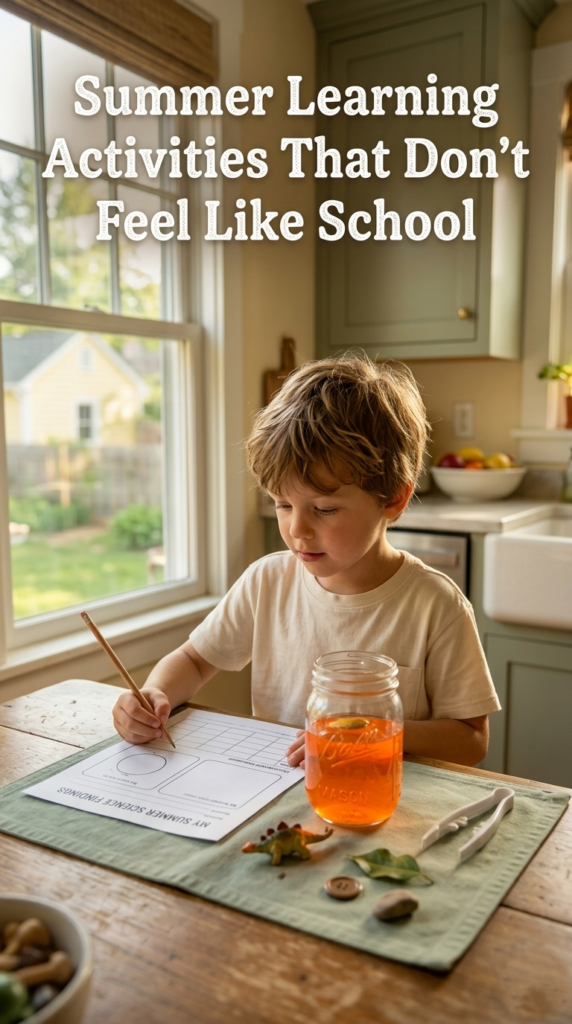
Kitchen science experiments — Baking soda and vinegar volcanoes, making slime, growing crystals, testing what floats and sinks. These are easy to find with a quick search and require nothing beyond pantry items. The mess is worth the engagement.
Printable science activity packs — Pre-designed experiments with instruction cards, observation sheets, and recording pages. These work particularly well for parents who want to offer structured science activities without having to research and plan each one themselves.
How Much Summer Learning Is Enough
The research suggests that 30 minutes of reading or academic activity per day is enough to prevent summer slide for most kids. That’s genuinely not a lot. A short reading session in the morning, a game after lunch, a journal entry before bed — spread through the day, it barely feels like structure at all.
The mistake is trying to front-load it all into a two-hour “school block” that kids resist from day one. Small, consistent, varied activities woven into the summer rhythm work better than concentrated sessions that feel like school.
Frequently Asked Questions
How do you make summer learning fun for kids who hate school?
By making it not look like school. The activities that maintain skills over summer — reading chosen books, playing math games, cooking, keeping a nature journal — don’t resemble a classroom. Kids who resist worksheets will often engage readily with the same underlying skills presented differently. Focus on what they find genuinely interesting and find the learning inside that.
What is summer learning loss and how bad is it?
Summer learning loss refers to the academic regression that occurs over summer break without any learning engagement. Research finds that students can lose one to two months of reading skill and more in math over a typical summer. The effect compounds over multiple summers, contributing to achievement gaps that are measurable by middle school. Thirty minutes of daily reading is enough to prevent most of it.
Are printable activity packs good for summer learning?
Yes — particularly for parents who want ready-to-use activities without the planning overhead. Good activity packs mix skill practice with games, creative activities, and puzzles so they don’t feel like worksheets. They’re especially useful for quiet time, rainy days, and travel. The key is choosing age-appropriate packs with enough variety to hold a child’s interest through multiple sessions.
How do you prevent the summer slide without ruining summer?
Keep it light, keep it short, and keep it consistent. Thirty minutes of reading per day, a few math activities per week, and some creative or exploratory projects spread through the summer is genuinely enough. Build it into the daily rhythm rather than blocking out formal learning time, and let kids have real input into what they read and explore. Summer should still feel like summer — you’re just keeping the brain from going completely offline for three months.
Try PinCraft AI Free Today
Design beautiful Pinterest pins in seconds with AI. Start your free trial — no credit card needed.

Helping creators use AI tools and Pinterest to build digital product income from home.