Working from home with kids out of school for the summer is genuinely one of the harder logistics problems in the modern work-from-home world. The kids need engagement, you need concentration, and the overlap between those two things is smaller than it looks on paper.
But here’s what actually helps: structure. Not a packed schedule that requires you to facilitate every minute — a predictable rhythm that kids can count on and that builds in real quiet time for you. Once children know what to expect and when, the constant “what are we doing now” interruptions drop dramatically.
This is what worked for me — and what I’ve seen work for a lot of other women running businesses from home while managing a household at the same time.
Some links here are affiliate links. I may earn a small commission at no extra cost to you. ✨
The Real Problem With Summer Work-From-Home
The issue isn’t usually that kids are being difficult. It’s that they don’t have enough independent activity to sustain them through a work block. Kids who are used to a school schedule — where transitions happen on a predictable timer and activities are ready for them — genuinely struggle with unstructured days. They’re not being annoying. They’re bored and under-stimulated and coming to the person who usually has answers.
The fix isn’t finding better activities. It’s building a simple daily structure that takes the decision-making off both of you.
Build a Simple Summer Schedule (Not a Camp)
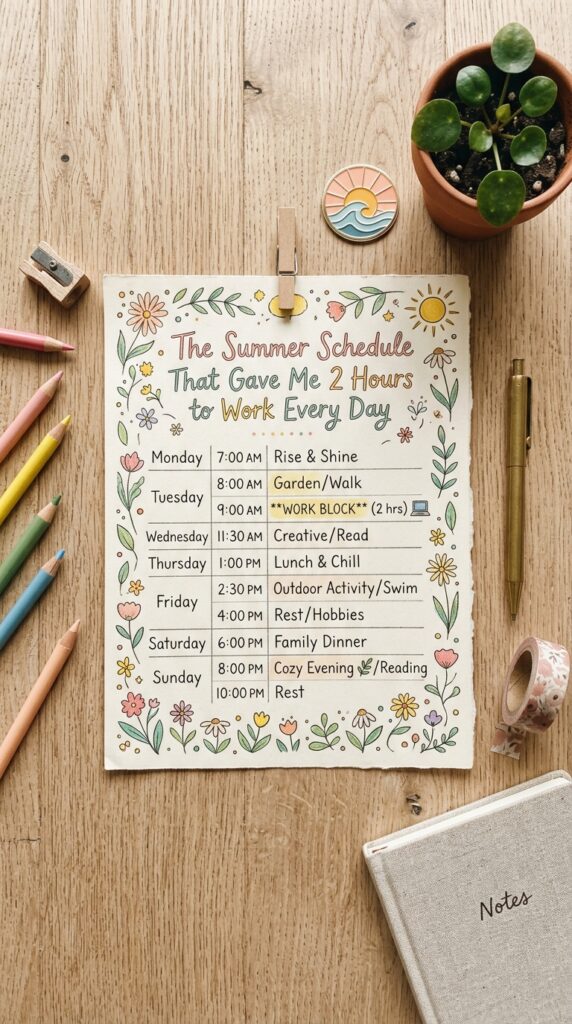
You don’t need a minute-by-minute plan. You need a rhythm that repeats. Here’s a framework that works for most families:
- Morning block (8am to 10am) — Outdoor or physical activity. This burns the morning energy before it becomes chaos. Backyard play, a walk, a bike ride, or a trip to the park.
- Quiet work block (10am to 12pm) — Your deep work time. Kids have independent activities — this is where printable packs, craft supplies, building toys, and books live. No interruptions unless it’s urgent.
- Lunch and free time (12pm to 2pm) — Lunch together, then looser time where you can work at a lower concentration level and check in more easily.
- Screen time (2pm to 4pm) — Scheduled screen time is easier to manage than negotiated screen time. When kids know it’s coming, they’re less likely to ask for it all morning.
- Outside or errands (4pm to 6pm) — Wrap up your work day and transition the afternoon.
The key is that quiet work block from 10 to 12. That’s your most valuable two hours. What you put in it for the kids determines whether you actually get to use it.
What to Put in the Quiet Work Block
This is the practical question — and the answer is: independent activities that require zero facilitation from you. The moment an activity requires you to set it up, explain it, or troubleshoot it in real time, it’s not a quiet work block activity.
What actually works:
Printable activity packs — Specifically designed to be self-directed. A good pack has enough variety (word searches, mazes, coloring, drawing prompts, writing activities) that kids can move through it independently for 30 to 60 minutes. These work especially well for ages five to twelve. Have a fresh one ready each week so it stays novel.
LEGO or building sets — Long independent play time, no facilitation required. Give a specific challenge (“build something that can hold a book”) to extend the activity.
Books and reading challenges — A summer reading log with small incentives keeps older kids reading independently. The library’s summer program often provides structure for this at no cost.
Art supply station — A dedicated drawer or bin with paper, markers, stickers, scissors, and glue that kids can access freely. No permission needed, no setup required from you.
Audiobooks — For kids who don’t love reading but can listen. An audiobook on a tablet with headphones buys genuinely long stretches of quiet. Libby through your local library is free.
The Activity Rotation System
Instead of thinking of new activities every morning, set up five activity stations and rotate through them on a weekly or bi-weekly basis:
- Station 1: Art and craft supplies
- Station 2: Building toys (LEGO, magnetic tiles, blocks)
- Station 3: Printable activity pack for the week
- Station 4: Books and reading corner
- Station 5: Outdoor activity (chalk, water play, obstacle course)
Each station gets a rotation. Monday is art, Tuesday is building, and so on. The predictability removes the negotiation and the “I don’t want to do that” because it’s just what’s happening today — not a choice you’re presenting for debate.

Managing the Interruptions That Still Happen
Even with the best structure, interruptions happen. Here’s what reduces them without making kids feel shut out:
A physical signal system — A colored card or simple sign on your desk. Green means you can interrupt for anything. Yellow means only if it’s important. Red means only for emergencies. Kids as young as five understand this, and it reduces the “just one quick question” spiral significantly.
A sticky note question system — Instead of interrupting to ask something, older kids write their question on a sticky note and put it on your desk. You answer at your next break. This alone reduces interruptions by about half.
Snack prep in the morning — Set up a snack station before your work block so kids can help themselves. The number of times “I’m hungry” interrupts a work session is genuinely significant. Remove that variable.
When You Have a Meeting or a Deadline
The above routine works for typical work-from-home days. For times when you have a call or an urgent deadline, you need a different tier of activity — something that provides longer uninterrupted engagement.
A few options that reliably buy 45 to 60 minutes:
- A new craft kit or activity box they haven’t seen before
- An audiobook they’re invested in
- Baking something simple they can do mostly independently
- A specific challenge with a small reward attached — “if you give me quiet until my call is done, we’ll do something you choose after”
Frequently Asked Questions
How do you work from home with young kids in summer without losing your mind?
Structure is the honest answer. The women who manage this well aren’t doing it through willpower or perfect kids — they’ve built a daily rhythm that gives children predictability and gives them protected work time. It doesn’t need to be complex. A consistent morning routine, a defined quiet work block, and scheduled screen time covers most of it.
What age can kids play independently for longer stretches?
Most children can sustain 30 minutes of independent play by age four, 45 to 60 minutes by age six, and one to two hours by age eight or nine — with the right activities available. The key is that the activity is appropriate for their age and interest level and doesn’t require adult facilitation to work.
Are printable activity packs worth it for summer quiet time?
Genuinely yes — especially for ages five to twelve. A well-designed pack includes enough variety that kids can self-direct through it without needing help. The fact that they’re printed rather than screen-based also means they count as “non-screen time” which matters if you’re managing overall screen exposure. They’re one of the most reliable independent activity tools that exist.
How do I explain to my kids that I’m working even though I’m home?
Simply and directly. “When I’m at my desk with the [signal], I’m at work. I’m home, but I’m working, the same way a teacher is at school even when they’re in the building.” Most kids understand this with one clear explanation better than they respond to repeated reminders in the moment. Give them a visual cue, explain it once, and enforce it consistently.
Try PinCraft AI Free Today
Design beautiful Pinterest pins in seconds with AI. Start your free trial — no credit card needed.

Helping creators use AI tools and Pinterest to build digital product income from home.